

Profile: Ray Walsh and Capitello Wines
/For such a young and relatively small wine region, Oregon has more than its share of foreign investment, interest, and ongoing connections. The presence of French wine makers and brands, in particular, is taken as a local affirmation. Having visited New Zealand, I was keen to learn more about Ray Walsh who makes wine there and in the Willamette Valley.
This appeared in the November 2026 issue of Oregon Wine Press.
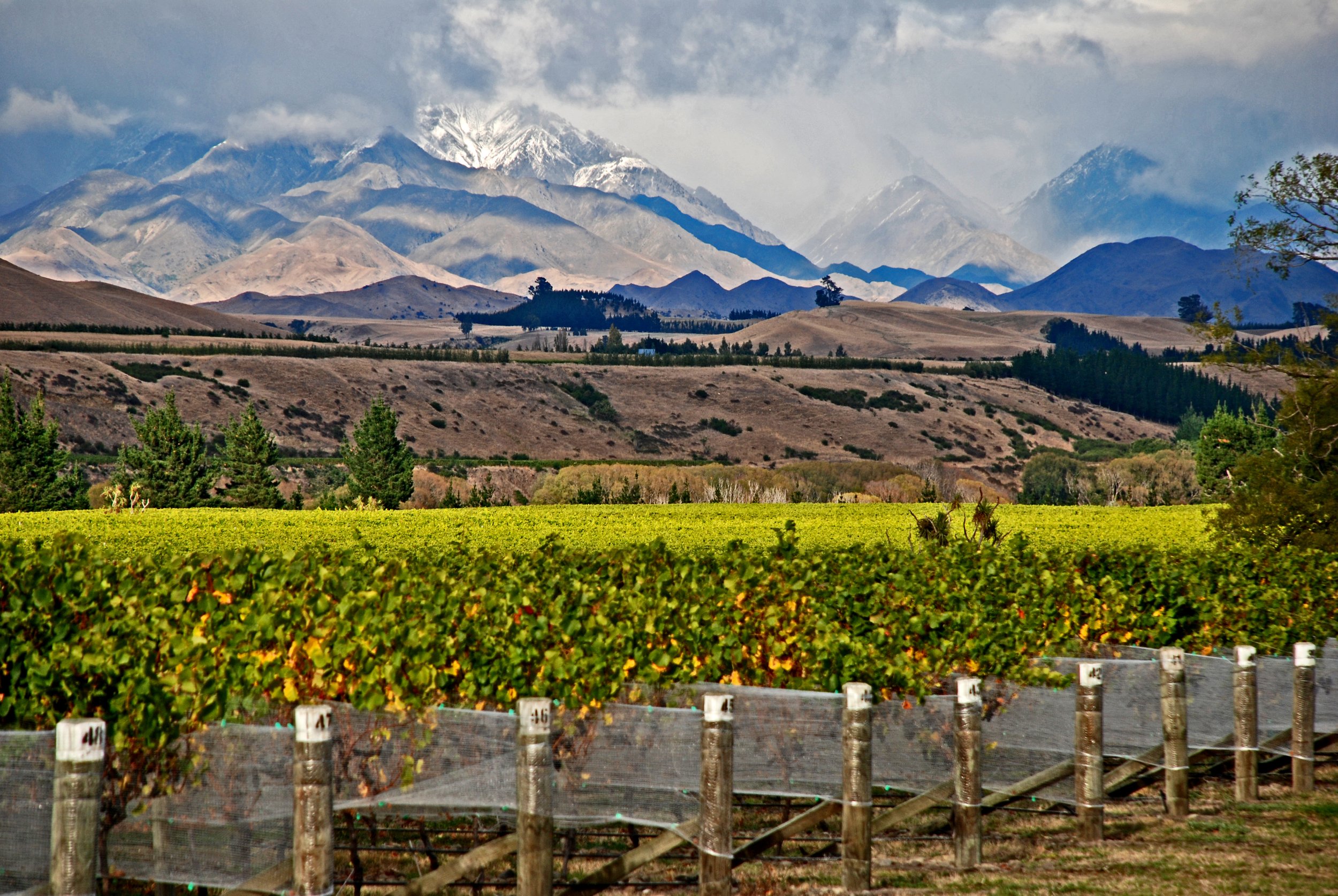
Awatere Valley vineyards in autumn, Marlborough, New Zealand [wikimedia commons]
One challenge of learning to make wine is that the chance to practice the craft comes only once a year.
But the opportunities double by traveling between wine regions of the northern and southern hemispheres. Informally called “chasing harvest,” the practice is a well-worn rite of passage for interns and trainees.
Less common is a winemaker with a career-long commitment as a flying winemaker. Ray Walsh, founder and winemaker of Capitello Wines, offers Willamette Valley wines sourced from vineyards near Eugene, as well as Marlborough wines from his native New Zealand.
The veteran winemaker now calls Oregon home, but regularly travels back to his homeland for harvest, trials and bottling of the wines he will import. In so doing, he leverages two harvests a year to test new techniques for his Capitello wines and the Oregon brands that employ him as their winemaker.
INSPIRATION ABROAD
Wine was part of Walsh’s world growing up in New Zealand, but the idea of pursuing it as a career took time to arise. Following a brief attempt at college, the young Walsh set out to see the world, a sojourn that began in nearby Australia and soon ventured further abroad.
His adventure eventually landed him in a German village in the Mosel, the celebrated Riesling appellation. His host family invited him to pick fruit in their steep vineyards and to help ferment the wine in the cellar beneath their home. Recalling the story in a 2022 interview with Rich Schmidt of Linfield University’s Oregon Wine History Archive, Walsh remembers thinking, “This is the coolest thing, and I want to do this. It really inspired me.”
He returned home for a second try at college, this time more clearly focused on his vocational goal. Studying viticulture led to a role with the Villa Maria Group and, later, alongside winemaker Kim Crawford at Coopers Creek – two different approaches to New Zealand winemaking.
A 1980s road trip through North America’s West Coast wine regions convinced him the Willamette Valley — not California, where he expected to land — was the highlight. In the early 1990s, he returned to Oregon to assist winemaker Will Bucklin for a couple of harvests at King Estate Winery, giving him the chance to work with fruit from 40 vineyards across the valley. Eventually enticed into a two-year contract, he settled into Oregon life. “Two years quickly became 10,” he told Schmidt. When Bucklin returned to his family’s Sonoma vineyard, Walsh took over at King Estate.
A series of promotions increasingly sequestered Walsh behind a desk. It was not to his liking.
“The large wineries gave me wonderful opportunities to learn a lot of stuff and play with a lot of techniques that small wineries don’t have the financial means to do,” he affirms. “But you get to the stage where you start looking internally, at what do you want to do yourself. For me it was just getting back into hands-on winemaking.”
Capitello was born.
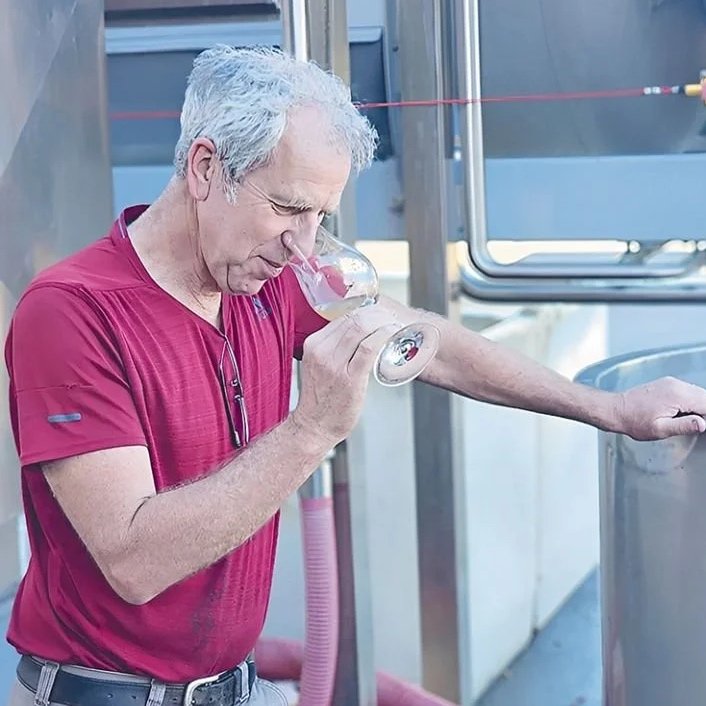
Ray walsh [photo: capitello wines]
DEFINING A BRAND
Despite working in two hemispheres, Walsh intends to keep production small enough to handle himself. “It’s the part I really enjoy doing, and I’ve designed my business to continue that way,” he says.
Unafraid to innovate, he continually ponders, “What little tweaks can I make to make that a better wine? I find that, for me personally, it stops me from being complacent, and that’s something I never want to be in my winemaking.”
COMPARE AND CONTRAST
Although more than 7,000 miles apart, the Willamette Valley and Marlborough are both part of wine’s “New World.” Their wine industries flourished concurrently during the last quarter of the 20th century, and each has built its identity around a single variety - Sauvignon Blanc in Marlborough and Pinot Noir in the Willamette Valley. Vineyard sustainability is also a shared value.
Marlborough, at the northern end of the country’s South Island, is by far the larger wine producer, and its Sauvignon Blanc is a major export. “We’re only an island of a little over five million people, so we produce way more wine than we could ever consume,” Walsh observes. In the southern Willamette Valley, by contrast, small, family-owned brands abound, with limited reach beyond the domestic market.
Climate resemblances also link Marlborough and the Willamette Valley. The regions occupy similar latitudes in their respective hemispheres and are both included in Region One of the Winkler Index, a measure of an area’s annual heat accumulation. Temperatures in both places are moderated by maritime breezes that reach vineyards after passing through mountain ranges.
Contrasts are evident in the soils and in annual rainfall. Riverbeds and the alluvial deposits they retained from ancient floods shaped the land in each place. Known as graywacke in Marlborough, these gravels are free-draining but relatively low in nutrients. The rocks force vines to root deeply, a dynamic many winemakers believe intensifies flavor.
But in Oregon, growers consider the silt left by the Ice Age Missoula Floods on the Willamette Valley floor too fertile for wine grapes, and migrate to hillsides above the floodplain. Older basalt and ancient seabed sediments form the soils there, including Jory, Willakenzie and Laurelwood.
Unsurprisingly, Oregon is the wetter of the two places, with significantly more annual rainfall than Marlborough.
THE WINES
Sauvignon Blanc production in New Zealand is massive, at nearly 250 million liters annually. By comparison, every drop of wine made in Oregon each year - of any variety - adds up to about 52 million liters. New Zealand produces about five times as much Sauvignon Blanc as Oregon produces of all its wines combined.
Walsh makes Sauvignon Blanc in both places. “Thirty years ago when I first came here, a lot of people were very skeptical of that varietal, didn’t think they could ripen it,” Walsh recalled. “I always thought the Willamette Valley is a great place for it.”
Walsh prefers stainless steel tanks for fermentation in Marlborough. But his Willamette Valley fruit leads him down a different path. “It’s more tropical than what I’m used to in New Zealand,” he said. “For me, I decided the best way to work with that was to ferment in concrete eggs. I felt that would round the wine out to suit that more tropical character.”
Side by side on Capitello’s tasting room bar, both versions exhibit the bright, bracing acidity associated with the variety along with their own flavors. “It’s one varietal that people are not on the fence about,” Walsh notes. “They either like it or don’t like it.”
Enter Sauvignon Gris.
Gris is Sauvignon Blanc’s rare, pinkish cousin, believed extinct after the phylloxera scourge of the 19th century until a surviving Loire block was identified in 1980. Walsh has partnered with vineyard owners Andy and Kyna Laurie to grow it in Marlborough and at their Elkhead Vineyard south of Eugene — the first Sauvignon Gris planting in Oregon, according to Capitello.
“Sauvignon Gris has that same tropical, ‘Sauvie’ aroma profile, but has more of a ‘gris’ finish to it,” according to Walsh. “It doesn’t have that high acidity, so it finishes much smoother, with more of a floral finish, like a Pinot Gris, so it really surprises people.”
Turning to his Pinot Noirs, Walsh compares the intensity of the Marlborough versions with the nuance possible in the Willamette Valley. The prevailing winemaking techniques for the variety in New Zealand “give you a little more structure, color, overall intensity,” he says. “It’s going to be one of those wines that, aromatically, is going to jump out of the glass. But they don’t have the complexity of what we achieve here in the Willamette Valley.”
Rotating two sets of barrels gives Walsh the opportunity to age his Oregon Pinots for as long as he feels they need - 14, 18 or 24 months. “The beauty and the smoothness, the velvety tones, everything you get in Pinot Noir when you do that extra time in barrel, is worth every penny,” he says.
Oak barrels and concrete eggs both play a role in making Capitello’s Chardonnays. Seeking to retain a lighter, more refreshing approach to the variety, these wines skip malolactic fermentation, according to AnnaMae Roome, Capitello’s tasting room manager.
Walsh made a few sparkling wines early in his career, but is happily embracing the renewed local interest to offer two multi-vintage bottlings. The Prestige Cuvée is a sparkling rosé of Pinot Noir, and the Celebration Cuvée employs the traditional Champagne blend of Pinot Noir, Chardonnay and Pinot Meunier. Both are made using the traditional method and spend five years en tirage.
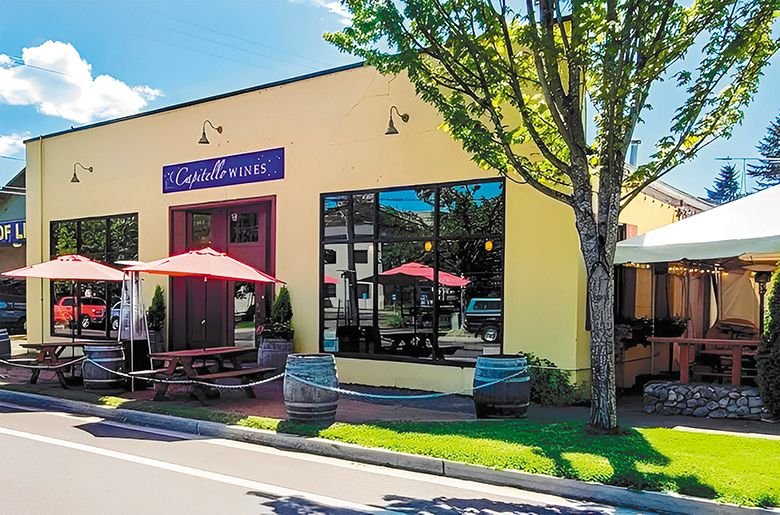
capitello’s tasting room in eugene, Oregon
EUGENE SUCCESS
A varied calendar of events and the Beccofino food truck’s regular hours fill the spacious indoor and outdoor gathering spaces at Capitello’s tasting room in Eugene. “We’ve got six still whites available, and four reds, two sparklings, and a dessert. So there’s always something for everyone,” Roome notes. “One of the most popular flight tastings we do compares our three Oregon and New Zealand wines, and I think customers really enjoy seeing the differences.”
Despite the doom-and-gloom in some industry quarters, business is good at Capitello. “We’re really in a wonderful niche,” Walsh says. “I think the people that are still enjoying wine are looking for quality wines… And they’re looking for ones that are not ego-priced, where they can get really good quality for the dollar. I felt that was where we stood all along.”
Walsh’s passion is to keep learning, and two hemispheres give him twice the classroom. The Willamette Valley and Marlborough put different accents on the same restless curiosity that ignited in that Mosel vineyard four decades ago. Capitello’s wines bridge two far-flung wine regions while proving that one winemaker can master both.


