

A Wine Lover's Guide to Chocolate
/Written for the February 2026 issue of Oregon Wine Press (think: Valentine’s Day!), this is one of my longest writing projects to date. Long in word count, but also in time and effort. The published version, “Bar Exam” can be found HERE.
"Wine is a treat, and chocolate is a treat. Why not enjoy them together?"
The woman juggling her glass and a bit of chocolate at an urban wine walk seemed to have it figured out when I asked if she often eats chocolate with wine. "Why choose between the two when you can have both?"
Her reply occupied my mind as I continued pouring rosé and Chardonnay in the back of Azar Indulgences, a jewel-box shop tucked into the front corner of Portland's Heathman Hotel. A winery had dispatched me with wine to share with the walkers and proprietor Christine Azar paired every pour with chocolate samples.
Wine and chocolate rank among nature's most delicious gifts. They are also among the most complex. Both can impart a wide range of flavors that reveal their origins. They also convey the style, values and intentions of the people who craft them.
But do they belong together? I've always been a skeptic. So I decided to learn more.
wikimedia
A Lot in Common
As with fine wine, high-quality chocolate is often sourced from a specific region, which lends distinct flavors to the final product. Both benefit from the careful craft of makers working in small batches.
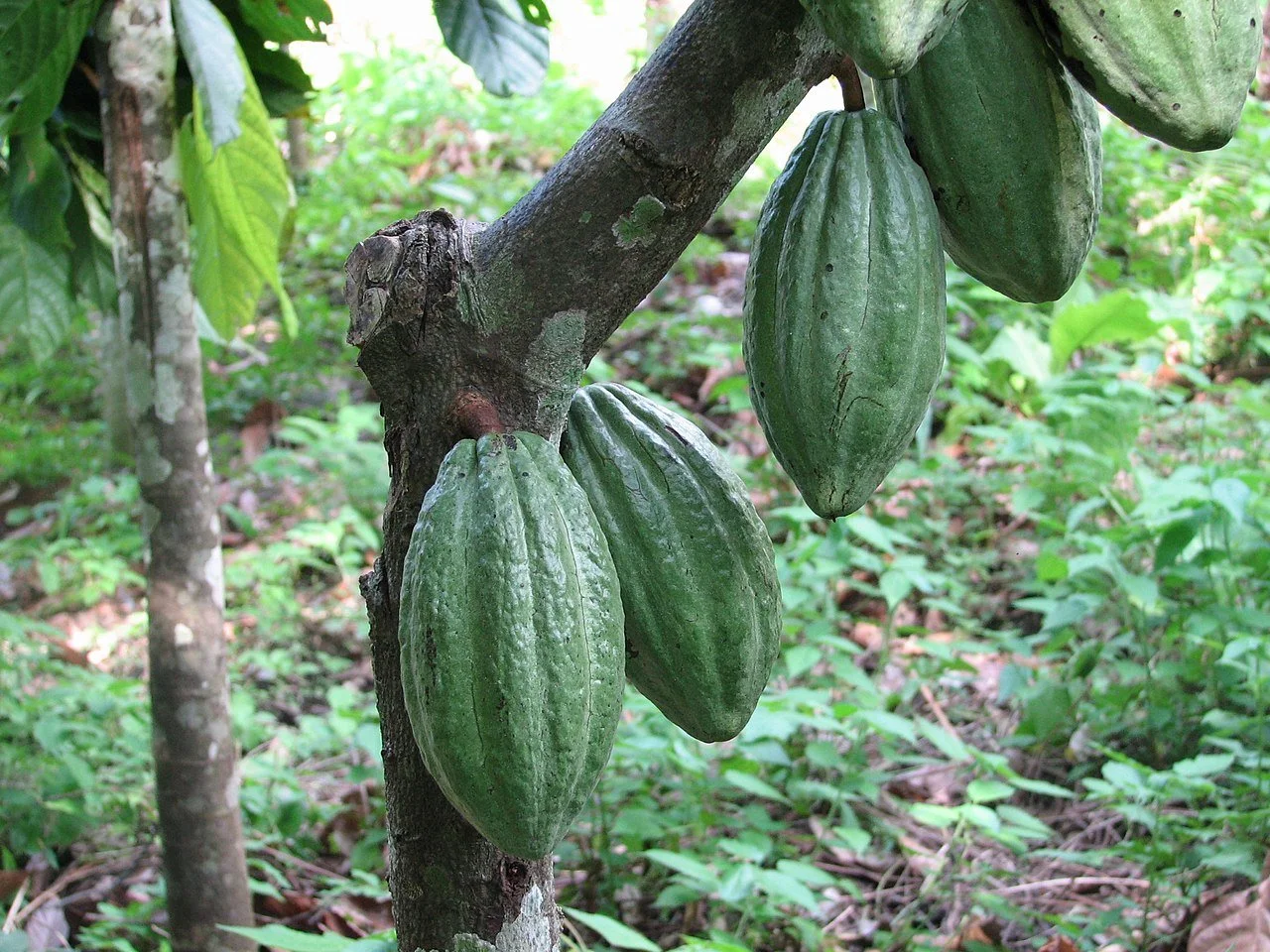
Chocolate starts its journey on tropical cacao trees, where brightly colored pods grow straight from the trunk. The "cocoa belt" is about 20 degrees either side of the equator, where the trees thrive in humid rainforest conditions. Côte d'Ivoire and Ghana produce over half of the world's chocolate, according to the National Oceanic and Atmospheric Administration. Other countries in Africa, along with Indonesia, Mexico and nations in South America are also leading producers.
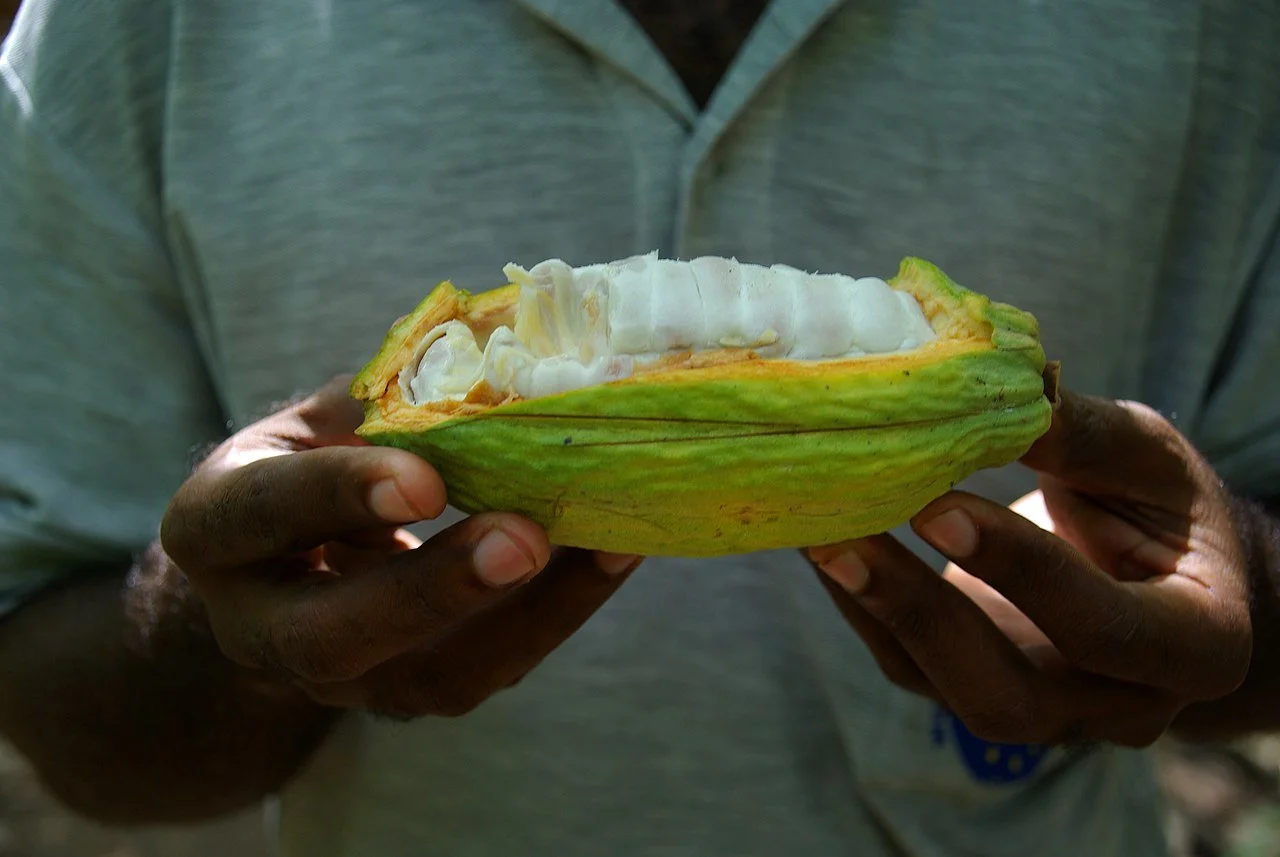
Inside the pods are seeds, or what we call beans, surrounded by a sweet, sticky pulp. Farmers scoop them out and let them ferment for several days, a crucial step that transforms their raw bitterness into the beginnings of chocolate flavor. Then they are dried, often out in the open sunshine. The growing location, fermentation and drying processes all contribute to a chocolate's terroir.
wikimedia
Once dried, the beans are shipped to chocolate makers, who roast them to their own specifications to deepen their aroma and flavors. After roasting, the beans are cracked and the inner nibs are separated from the surrounding brittle husks. The nibs are ground into a thick, rich paste between the granite wheels of a melanger, then blended with sugar, milk, cocoa butter or other flavorings.
The cacao percentage displayed on chocolate packaging indicates the proportion of the product made from nibs and cocoa butter versus sugar and other additives. The mixture is slowly stirred and smoothed until it becomes silky. Other "stir-ins," such as nuts, may be added before the cooled mixture is then shaped into bars or truffles. Tempering during this final step gives chocolate its glossy finish and satisfying snap.
Shared Craft
Like wine, chocolate may be mass-produced or "boutique." Craft chocolate producers, often referred to as "bean-to-bar," seek out unique beans that yield small batches of distinctive products. Their language reminds me of Oregon's winemakers.
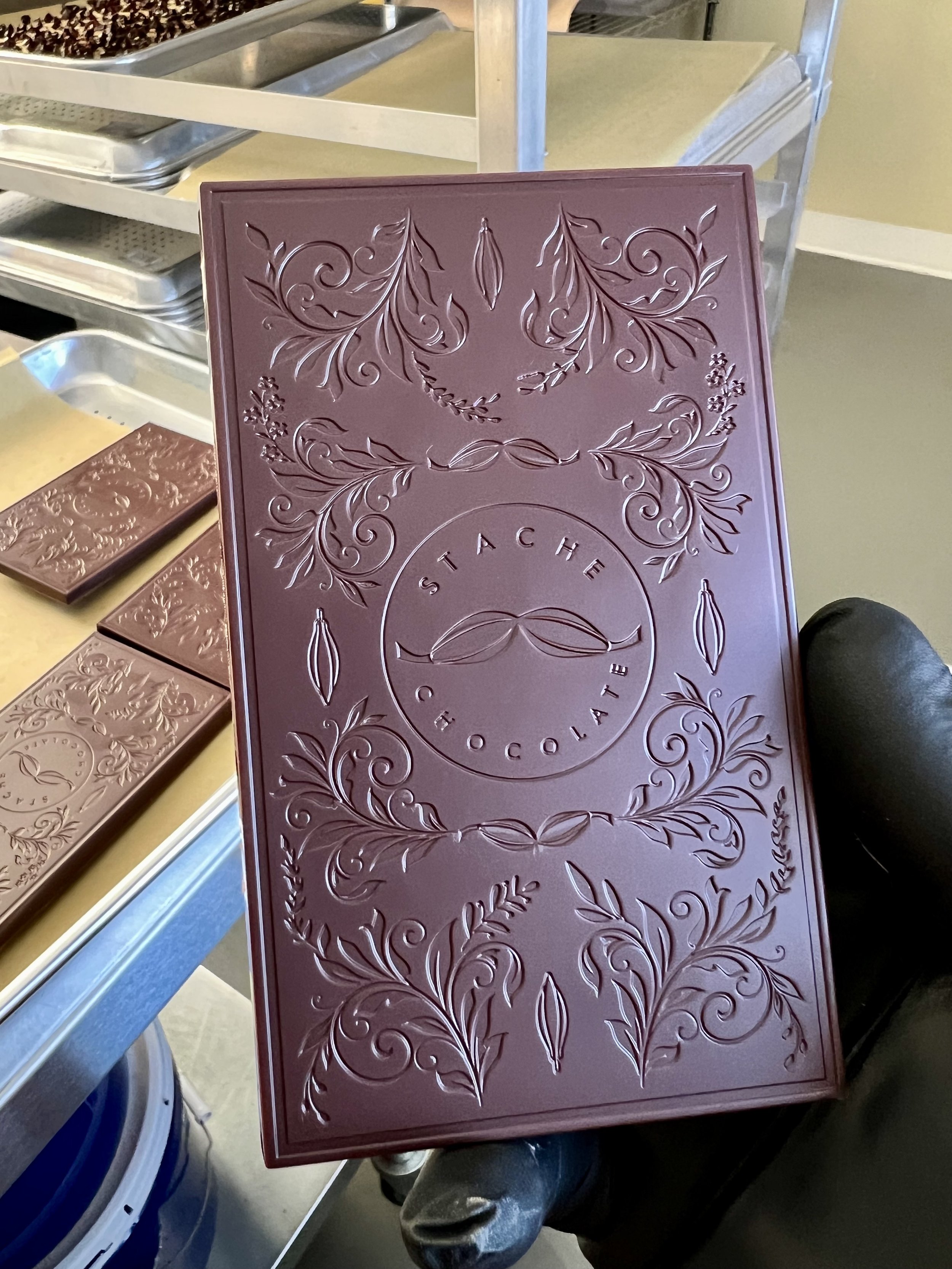
"In craft chocolate, we are trying to highlight those notes that the land, sky, and farmer have worked so hard to produce," said Eric Keppler of Stache Chocolate, a "nano batch" producer in Hillsboro. The creatively blended flavors of his bars reflect his decades of experience as a pastry chef and as the winner of HGTV's third season of "Best Baker in America." His bars feature unexpected additions like Chai tea, chilis and even bits of locally baked rye bread.
stache chocolate
"Once I know the bean's notes (is it nutty, citrusy, berry fruity, dried fruit, raisin, fig, earthy, etc.), I design the chocolate bar like I would a dessert," he explains, adding, "pairing those notes to wine is fun and can be a magical thing when done correctly and elevates both the wine and the chocolate to be greater than their parts."
Common Conscience
The wine world's concerns about sustainable farming and the treatment of vineyard stewards have parallels in the chocolate industry. Cocoa's extensive supply chain enables many "hands" to take a share of the retail price paid by the end consumer. Very little flows back to the cacao farmers, resulting in extreme poverty and extensive use of child labor and even slavery, especially in the small plantations of West Africa. According to the US Department of Labor, more than two million children in Ghana and Côte d'Ivoire work in hazardous conditions growing cacao.
Because cacao trees thrive in rainforests, the industry is responsible for significant deforestation as soils are depleted and yields on existing farms decline. Chocolate is also a water-intensive product. The Water Footprint Network estimates that it takes nearly 1,700 gallons of water to produce a pound of chocolate. A pound of beef requires 1,800.
Wine labels frequently display the logos of various sustainability certifications, and similar programs for ethically sourced chocolate identify suppliers that address child labor and environmental concerns. Fair Trade, Fair Trade Certified and Rainforest Alliance/UTZ are among the certifications to look for, although even these efforts draw criticism for insufficient inspections and accountability.
The Food Empowerment Project, a food justice non-profit, maintains a list of recommended chocolate producers and those to avoid on its website (https://foodispower.org/chocolate-list/) and smartphone app.
Back to Basics
"If you want to pair with chocolate, the wine has to be at least as sweet, if not sweeter than the dessert."
This basic rule of thumb was recounted by Levi Seed, Director of Hospitality and Lead Sommelier at the Joel Palmer House in Dayton. "Something like Port or Pedro Ximénez [Sherry] or Madeira, all of which have depth, sweetness, complexity, and can stand alone beside chocolate without being crushed by it." Lambrusco, Moscato d'Asti and sparkling wines labelled demi-sec or doux are more options.
Seed advocates focus on the structure of wine and food rather than only matching tasting notes. "[It's] not how the wine smells or tastes. It's how the wine actually feels physically on your palate." Alcohol, sugar, body, weight and texture all come into play.
He explains that in all wine-and-food pairings, the five basic elements of taste — sweet, sour, salt, bitterness and umami — can be experienced as congruent (sweet with sweet, for example) or complementary (sour with sweet — like the lemons and sugar in lemonade). How chocolate is combined with other flavors in a dessert, truffle or bar will influence the success of a pairing.
Getting Into It
Willamette Valley Vineyards has partnered with Whimsy Chocolates, a family business in Battle Ground, Washington, whose candy is distributed regionally. Initially, their flavored meltaways were destined for WVV's gift shop, but soon they became the centerpiece of seasonal tasting flights.
In a meltaway, coconut oil is blended with chocolate, forming a solid candy with a rich texture, different from a truffle, which is a flavored ganache filling encased in a chocolate shell. At WVV's Estate tasting room in Turner, a sparkling Brut might be paired with a Strawberry Champagne meltaway, a Sauvignon Blanc with one modeled on key lime pie and a Black Forest truffle might accompany a Pinot Noir.
At WVV's sparkling wine-focused location, Domaine Willamette in Dayton, Whimsy’s meltaways are infused with the very wines they accompany. Dried fruits, such as oranges and strawberries, are soaked in the wine and then combined with white chocolate. A pinch of Pop Rocks candy ties the texture to the wine's bubbles.
"It finishes with a little bit of a fizz, nothing wild or obnoxious," said Whimsy's co-owner Pamela Wanous. "We wanted to make it very delicate and enjoyable."
Wanous and the WVV staff meet regularly to taste new combinations. Notes of the most successful pairings are retained for future vintages.
"This partnership is exciting not only for wine lovers but also for our staff," reports Dianira Piceno, WVV's Communications Associate. "We rotate our wine flights and chocolate tastings every month to keep the experience fresh and give guests something new to look forward to."
Further Afield
Karl Mecklem and Raechel Gano at Eagle's Nest Reserve in Hillsboro have collaborated with the already-mentioned Eric Keppler's Stache Chocolate to create custom complements for their Pinot Noirs, Rosé and Blanc de Noir. Gano recalls the like-mindedness they discovered when they first met three years ago.
"[Eric] was talking about sourcing different beans and how the different growing regions of cacao can affect the flavors of the beans, without even adding anything to the bars," she recalls.
They choose a flight of three wines, and Keppler creates a flavored chocolate to pair with each. To single-source chocolates from Vietnam, Peru and Madagascar, he adds savory elements like chamomile, cassava root, seaweed, cardamom and peppercorns. Sweeter elements, such as pear, honeydew, oat milk and bee pollen, are also used.
"There is this really nice dance that happens with wine and chocolate," said Mecklem, citing what he sees as the complementary elements of cocoa butter's fat and the acidity of wine. The chocolate's purity and the added flavors allow Keppler to reduce the prominence of sugar.
"What [Eric] crafts is very well balanced," notes Mecklem. "You go through these waves of different flavors, and then in the middle… you're going into some of these other flavors that he puts into it, and then the finish is kind of a combination."
It Gets Complicated
"I think there's nothing worse than pairing the wrong chocolate with the wrong wine," said Christine Azar when I circled back around to her. A native of Lebanon, Azar brings an appreciation for the flavor world of that region's sweets, reflected in the products available at Azar Indulgences.
She recalls meeting with a skeptical winemaker when choosing wines to sell at a previous incarnation of her chocolate shop. What could they pair with his delicious GSM (Grenache, Syrah and Mourvèdre blend)? The answer was a truffle featuring za'atar, a Middle Eastern seasoning that combines oregano, sumac, sesame and more. "We had made it in a milk chocolate, and it went so beautifully with the GSM; he was blown away," she recalls. They immediately tried a brownie with the same wine. "It was so gross," she said. "All we tasted from the chocolate brownie was the oils… it was just awful with it."
Azar echoed that the sweetness level is an essential consideration when seeking delicious combinations. She notes that high levels of sugar can mask a chocolate's own unique flavor as well as the flavors that accompany it. Describing her shop's berry cheesecake truffle, she says, "You can taste the fruit that's inside the piece, the truffle, but you can also taste the dark chocolate on the outside of it, because the dark chocolate is not as sweet. So they play off of each other, really, really well."
Trial and Error
I was beginning to understand that trial and error play a part in finding successful combinations.
In a chance meeting at a wine tasting, Rik Shattil and I discovered a shared interest in chocolate and wine pairing. We arranged to meet in La Biblioteca Wine's tasting room, located in the Dundee Hotel, armed with a dozen bars of chocolate made in Oregon and beyond.
Monica Swanson, La Biblioteca's Hospitality Manager, hosted us and joined in the tasting. She had glasses at the ready containing their Estate Reserve Chardonnay (2022, 25 percent new oak) and two Pinot Noirs from the McMinnville AVA: Title Page (2022, single-vineyard, whole cluster, Pommard clone, 25 percent new oak) and End Papers (2021, single-vineyard, Pommard clone). Alongside these was a Columbia Valley Cabernet Franc from North Valley Vineyards, one of the other tasting rooms that share the hotel's ground floor.
The selected chocolate bars were found in the aisles of local premium grocery stores, where the variety rivals that of the wine section. We only tasted bar chocolate, mostly unflavored dark varieties, leaning heavily toward local producers.
Portland and the Pacific Northwest have emerged as a center for craft chocolate over the past two decades. Sharing the ethos of many Oregon winemakers, these are people concerned with sourcing beans directly, minimal-ingredient (low-intervention) recipes, ethical farming and small production quantities.
What began here with a few pioneers has grown significantly. Over 30 makers and nearly 2,000 attendees gathered for the weekend-long Portland Craft Chocolate Festival last October. (Plan to attend the next one, October 2-4, 2026. pdxccf.com) A post-festival press release quotes George Domurot, founder of Ranger Chocolate Co., reflecting on the inaugural year: "The enthusiasm from both participants and guests shows that there's a true appetite for the craft chocolate movement here."
This was good news as we tore open the wrappers.
I hoped this experience would inspire me to distill some pairing guidelines to pass along. The only rule I learned is: try it and see.
Here are some takeaways:
Seventy percent cacao seems to be a good starting point for pairing attempts. Higher cacao percentages were more earthy and roasty, but were generally less palatable with the red wines.
The "Nutrition Facts" box on chocolate packaging lets you compare ingredients, especially sugar levels. The kind of sugar used also affects flavor.
Sugar content doesn't always yield the result one might expect. Nor does the addition of salt, nuts or other flavors. This was truly "trial and error."
The savory structure imparted by Title Page's stem inclusion made it the most consistently successful pairing partner.
The most astounding combination was Belgian milk chocolate (33 percent cacao) with Chardonnay. Of all the pairings, this one rendered the sought-after ideal of something greater than the sum of its parts. The flavors of the lightly oaked wine brought out the rich dairy notes of the chocolate, creating a mouth-filling caramel.
Chocolate and Wine
After all this, would I order a glass of Pinot Noir to go with a chocolate dessert instead of a nice cup of coffee? Probably not. But I might snap off a square of artisanal chocolate to accompany a glass of wine on a Netflix night at home.
Wine and chocolate are among nature's most delicious treats. Combining them can be magical, but that probably won't happen accidentally. And, as with wine alone, a successful pairing is in the "mouth of the beholder." What delights one palate may repel another.
Fortunately, Oregon is a place where like-minded chocolate and wine makers thrive, and their crafts offer a veritable smorgasbord of possible combinations. Choose your own adventure and enjoy the ride.


